E-passports spread to half the globe
28 February, 2012
category: Contactless, Government, Library, Smart Cards
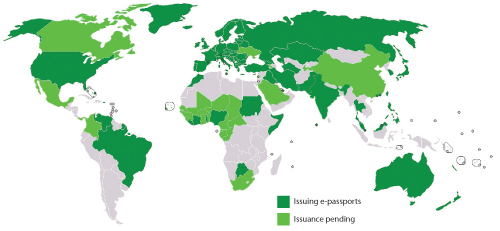
Nearly half of all United Nations (U.N.) member states are now issuing biometric e-passports, according to the newest data from the International Civil Aviation Organization (ICAO), the U.N. agency that oversees international air travel.
ICAO, which held its 20th TAG/MRTD meeting in September, reports that 93 out of 193 U.N. member states now issue e-passports, with 21 additional countries ready to deploy the technology in the next 12 to 48 months.
E-passport deployments
| Country | Start Date |
Annual Issuance |
Issued to Date |
PKDuse | Reading ePassports |
|---|---|---|---|---|---|
| Albania | Jun-09 | 450,000 | 900,000 | ||
| Algeria | 2010 | 500,000 | 500,000 | ||
| Andorra | Sep-06 | 4,000 | 19,000 | ||
| Argentina | 2010 | 2,000,000 | 1,500,000 | ||
| Australia | Oct-05 | 1,800,000 | 10,800,000 | Yes | Yes |
| Austria | Jun-06 | 500,000 | 2,500,000 | Yes | |
| Bahamas | Dec-07 | 52,000 | 200,000 | ||
| Belgium | Nov-04 | 500,000 | 3,500,000 | ||
| Bosnia Herzegovina | Oct-09 | 300,000 | 600,000 | ||
| Botswana | Mar-10 | 100,000 | 120,000 | ||
| Brazil | Jan-10 | 1,500,000 | 2,200,000 | ||
| Brunei | Feb-07 | 21,000 | 80,000 | ||
| Bulgaria | Mar-10 | 500,000 | 750,000 | ||
| Cambodia | Nov-08 | 220,000 | 600,000 | ||
| Canada (limited) | Jan-09 | 3,500,000 | 50,000 | Yes | Yes |
| Chile | Dec-09 | 300,000 | 480,000 | ||
| Congo Dem. Rep. | Apr-09 | 250,000 | 400,000 | ||
| Cote d’Ivoire | Jul-08 | 200,000 | 600,000 | ||
| Croatia | Jul-09 | 200,000 | 400,000 | ||
| Cyprus | Dec-10 | 32,000 | 16,000 | ||
| Czech Rep. | Sep-06 | 800,000 | 2,700,000 | Yes | |
| Denmark | Aug-06 | 750,000 | 3,750,000 | ||
| Dominican Rep. | May-04 | 480,000 | 3,360,000 | ||
| Estonia | May-07 | 50,000 | 200,000 | ||
| Finland | Aug-06 | 400,000 | 2,000,000 | Pending | |
| France | Apr-06 | 3,500,000 | 18,000,000 | Yes | |
| Gabon | Jan-09 | n/a | n/a | ||
| Georgia | Jun-10 | 35,000 | 35,000 | ||
| Germany | Nov-05 | 3,000,000 | 15,500,000 | Yes | Yes |
| Ghana | 2010 | 240,000 | 240,000 | ||
| Greece | Aug-06 | 1,000,000 | 4,000,000 | ||
| Hong Kong | Feb-07 | 500,000 | 1,500,000 | Yes | |
| Hungary | Aug-06 | 800,000 | 3,500,000 | Yes | |
| Iceland | May-06 | 45,000 | 200,000 | ||
| India | Jun-08 | 12,000,000 | 20,000,000 | Yes | |
| Indonesia | 2010 | 2,500,000 | 2,500,000 | Yes | |
| Iran | Jul-07 | 1,000,000 | 1,500,000 | ||
| Ireland | Oct-06 | 600,000 | 2,800,000 | Pending | |
| Italy | Oct-06 | 2,500,000 | 11,200,000 | ||
| Japan | Mar-06 | 4,200,000 | 20,000,000 | Yes | Yes |
| Kazakhstan | Jan-09 | 65,000 | 130,000 | Yes | |
| Korea (South) | Mar-08 | 4,000,000 | 10,000,000 | Yes | |
| Kosovo | 2010 | 300,000 | 200,000 | ||
| Latvia | Nov-07 | 300,000 | 1,000,000 | Yes | |
| Liberia | 2011 | 14,000 | 4,000 | ||
| Libya | 2009 | 20,000 | 30,000 | ||
| Liechtenstein | Oct-06 | 6,700 | 30,000 | ||
| Lithuania | Aug-06 | 230,000 | 1,100,000 | Pending | |
| Luxembourg | Aug-06 | 25,000 | 110,000 | Pending | |
| Macao | Sep-09 | 180,000 | 150,000 | Yes | |
| Macedonia | Apr-07 | 180,000 | 1,100,000 | ||
| Madagascar | 2010 | 80,000 | 80,000 | ||
| Malaysia | Mar-10 | 1,300,000 | 1,500,000 | ||
| Maldives | Jul-07 | 30,000 | 100,000 | ||
| Malta | Oct-08 | 16,000 | 40,000 | ||
| Monaco | Jul-05 | 3,000 | 18,000 | ||
| Montenegro | May-08 | 20,000 | 70,000 | ||
| Morocco | 2010 | 200,000 | 150,000 | Yes | |
| Mozambique | 2011 | 200,000 | 20,000 | ||
| Netherlands | Aug-06 | 1,800,000 | 10,000,000 | Yes | |
| New Zealand | Nov-05 | 720,000 | 2,600,000 | Yes | Yes |
| Nigeria | Aug-07 | 1,100,000 | 5,000,000 | Yes | |
| Norway | Oct-05 | 600,000 | 3,600,000 | Yes | |
| Philippines | Aug-08 | 5,000,000 | 12,000,000 | ||
| Poland | Aug-06 | 1,500,000 | 7,500,000 | ||
| Portugal | Jul-06 | 400,000 | 2,000,000 | Pending | Yes |
| Qatar | Apr-08 | 15,000 | 45,000 | ||
| Romania | Jan-09 | 1,000,000 | 2,000,000 | ||
| Russia | Sep-06 | 2,200,000 | 7,500,000 | Pending | |
| San Marino | Oct-06 | 2,000 | 10,000 | ||
| Senegal | Dec-07 | 620,000 | 1,300,000 | ||
| Serbia | Jul-08 | 440,000 | 1,300,000 | ||
| Singapore | Apr-06 | 600,000 | 3,000,000 | Yes | Yes |
| Slovakia | Jan-08 | 750,000 | 1,500,000 | Yes | |
| Slovenia | Aug-06 | 51,000 | 250,000 | ||
| Soloman Islands | 2009 | n/a | n/a | ||
| Somalia | Jan-07 | n/a | n/a | ||
| Spain | Aug-06 | 2,000,000 | 10,000,000 | Pending | |
| Sudan | May-09 | 100,000 | 200,000 | ||
| Sweden | Oct-05 | 825,000 | 5,100,000 | Pending | |
| Switzerland | Sep-06 | 750,000 | 3,500,000 | Yes | |
| Taiwan | Dec-08 | 1,500,000 | 4,000,000 | ||
| Tajilkistan (limited) | Feb-10 | 40,000 | 50,000 | ||
| Thailand | May-05 | 860,000 | 5,200,000 | ||
| Togo | Aug-09 | 30,000 | 50,000 | ||
| Turkey | Jun-10 | 1,430,000 | 1,500,000 | ||
| Turkmenistan | Jul-08 | 80,000 | 200,000 | ||
| United Arab Emirates | 2010 | 300,000 | 400,000 | Yes | |
| United Kingdom | Mar-06 | 5,000,000 | 27,000,000 | Yes | Yes |
| USA | Aug-06 | 13,000,000 | 72,000,000 | Yes | Yes |
| Vatican City | Jun-08 | 0 | 2,000 | ||
| Venezuela | Jul-07 | 420,000 | 1,200,000 |
Source: ICAO
ICAO estimates that as of July 2011, these 93 states have issued more than 345 million e-passports, of which almost 340 million are in circulation.
As per ICAO specifications, each of these documents contains a contactless integrated circuit chip that stores biometric data–i.e. facial, fingerprint or iris–of the passport holder as well as other encrypted identification data. Forty-five of the e-passport issuing states store both fingerprint and facial data on their documents, while 34 store only the facial data. The remaining 14 states currently use facial data, but will begin including fingerprints by the end of 2011.
According to ICAO’s findings, the U.S. remains the largest issuer with 72 million documents issued to date. The U.S. issued 13 million in the past year. The UK, which issued 5 million e-passports in 2011, ranks as the second largest issuer with 27 million in total.
By region, Europe leads the pack with multiple countries–notably France, Spain, Italy, the Netherlands and Germany–each issuing more than a million e-passports in the past year.
However, according to Acuity Market Intelligence, Europe will soon be challenged by the Asia Pacific region, which is projected to issue 55 million documents in 2014 alone, representing 42% of the global share. Altogether, Acuity projects that there will be 26 Asia Pacific nations issuing e-passports by 2014.
Japan and India are leading the Asia Pacific region each with 20 million e-passports issued to date. According to ICAO, India rolled out 12 million documents in the past year, compared to Japan’s 4 million. The two are followed by the Philippines with 12 million issued to date, followed by Australia with nearly 11 million.
Many states in Africa, Central America and South America have yet to commit to the new technology, although several major countries including Mexico and South Africa are among the 21 nations listed by ICAO as “pending” for e-passport deployments.
The other nations planning to issue e-passports in the near future include Armenia, Azerbaijan, Bahrain, Belarus, Cameroon, China, Colombia, Israel, Jamaica, Kenya, Kuwait, Lebanon, Oman, Panama, Saudi Arabia, Sri Lanka, Ukraine, Uzbekistan and Vietnam.
Issuance strong but usage lags
Despite the growing numbers, ICAO reports that less than a third of e-passport issuing nations participate in the organization’s Public Key Directory (PKD)–a system ICAO says is “key” in maintaining global interoperability of e-passports.
The PKD system acts as a central broker to manage the exchange of Public Key Infrastructure certificates and PKI certificate revocation lists. ICAO says the PKD plays a critical role in minimizing the volume of certificate lists that must be exchanged and is essential to keeping the exchange of these crucial lists accurate and timely.
Even fewer states use Automated Border Crossing systems, which require the traveler to pass through e-gates that verify the biometric information stored on the passport. ICAO reports that 15 nations now use the systems–of which six employ facial scans, six check fingerprints and the remaining three use both facial and fingerprint scans.
According to ICAO, just eight states read e-passports at airports and borders. These include the U.S., the U.K., Singapore, Portugal, New Zealand, Japan, Indonesia and Germany.
Report: 90% of passports chip-enabled by 2016
IMS Research predicts that within five years 90% of passport holders will be using e-passports with integrated smart card IC chips.
Nearly half of all current passports issued today use smart chip technology, thanks to a rapid migration started in 2007. “This trend is set to continue,” states Alex Green, author of the IMS report “Electronic Government and Health Care ID Cards.”
“There are still a few countries around the world that are not yet issuing e-passports. However, most have started and with the typical five to ten year replacement rates for passports, it is only a matter of time before all passports in circulation are e-passports,” explains Green.
The report examines the use of biometrics in e-passports, which is still largely limited to a digital image of the holders face stored on the IC.
Green says this will change: “By 2014, the situation is forecast to have been reversed. By this time the majority of passports being issued will also include additional biometric data such as one or more fingerprints, iris scans, etc.”